
Should Your Business Invest in SEO, Google Ads or Social Media?
When businesses start thinking seriously about digital marketing, one of the biggest questions is where to put the budget.
Should you invest in SEO?
Should you run Google Ads?
Should you advertise on Facebook and Instagram?
Should you be posting organically on social media?
The answer depends on what you are trying to achieve.
At MoMac, we generally do not believe every business needs to be everywhere. The right mix depends on the business, its customers, the market, the available budget and whether the priority is immediate leads, long-term visibility, brand awareness or a combination of all three.
For many businesses, the strongest digital marketing strategy eventually uses several channels together. But that does not mean you need to start with everything at once.
Start with the business objective
Before deciding where to spend money, the first question should be:
What are we actually trying to achieve?
A new service business that needs customers quickly may put more emphasis on Google Ads.
An established company with a strong referral network may get more value from investing in SEO and building its long-term search presence.
A consumer brand launching a new product may want to focus more heavily on Meta advertising and strong visual content.
A B2B company may prioritise SEO, LinkedIn and useful content that demonstrates capability and builds professional relationships.
The budget should follow the objective rather than simply splitting money evenly across every available platform.
What is the difference between Google Ads and social media advertising?
Google Ads and paid social advertising can both generate leads and sales, but they often reach customers at different stages.
Google Ads captures existing demand
Google Ads is particularly powerful because it can reach people who are actively looking for an answer.
Someone searching:
“commercial electrician Christchurch”
is likely already in the market for an electrician.
Someone searching:
“portable cabins for hire near me”
is actively considering that product or service.
These are often described as high-intent searches.
The customer has already identified a need. Your job is to make sure your business is visible when they start looking for the solution.
This is why we often use Google Ads when lead generation is the immediate priority. Our digital marketing proposals regularly position Google as a channel for capturing customers who are already searching, while ongoing management focuses on optimisation, testing and improving how the advertising budget performs.
Social advertising can create demand
Meta advertising across Facebook and Instagram works differently.
Rather than waiting for someone to search for the product or service, you can put your business in front of targeted audiences based on factors such as location, interests and behaviours.
That makes paid social particularly useful for brand awareness, education and introducing an offer to someone who may not have started actively searching yet.
The person may not have woken up that morning thinking they need your service.
But the right message, presented to the right audience with strong creative, might start that journey.
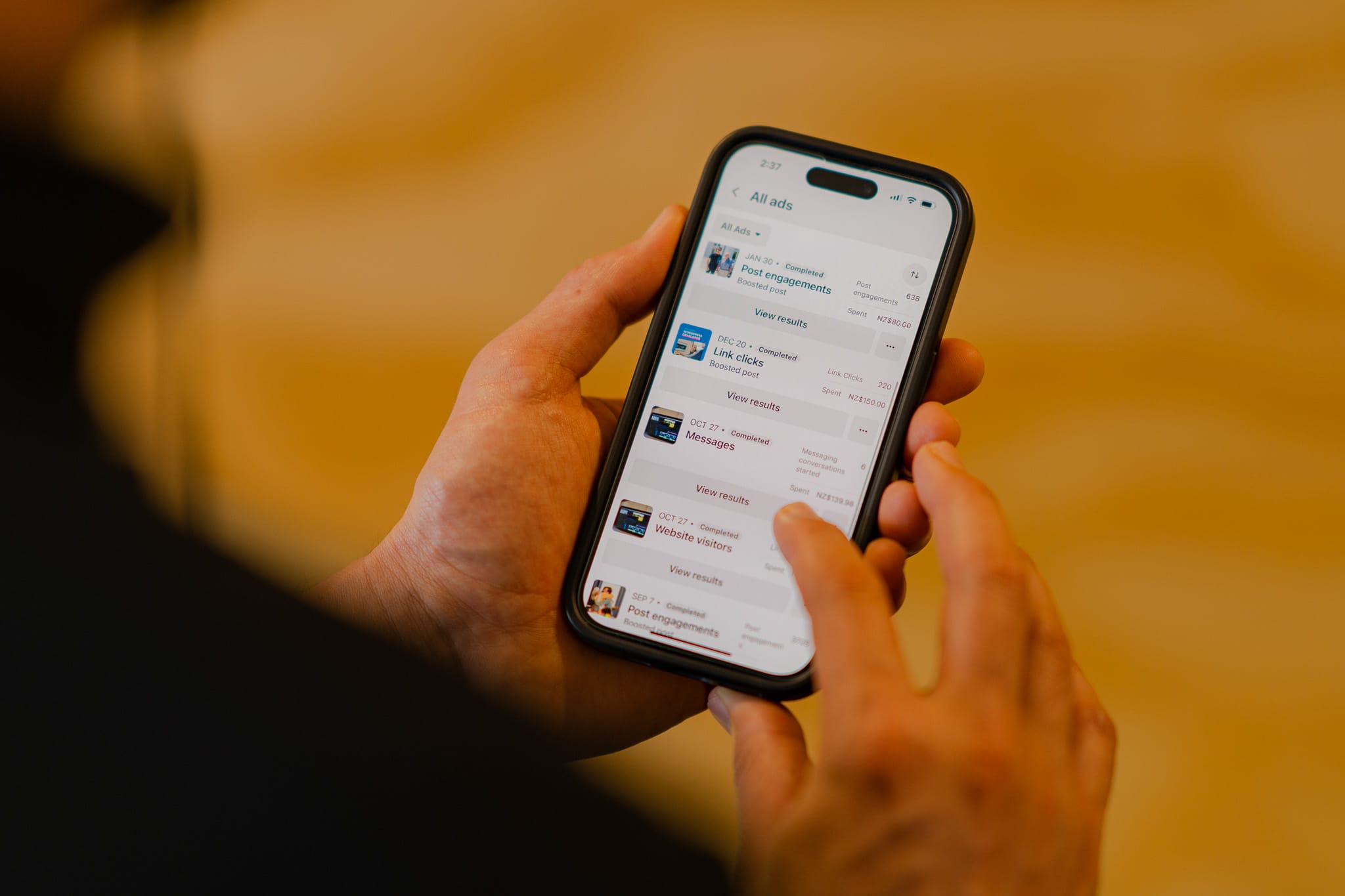
MoMac’s Meta campaigns typically combine audience targeting, creative, messaging, testing and ongoing optimisation rather than simply boosting a post and hoping it works.
Where does SEO fit?
SEO plays a different role again.
Google Ads gives you paid visibility while the campaign is running. SEO is about improving the organic strength of your website over the longer term.
This is why we tend to recommend SEO as part of the foundation of a good website.
If you are investing in a new website, it makes sense to think about how people will find it.
That can involve building the right service pages, creating useful content, improving page titles and descriptions, researching relevant keywords and continuing to add useful information over time.
Unlike advertising, SEO does not switch off because you stop paying for clicks.
A strong page that ranks well can continue producing website visits and enquiries long after it was originally created.
That does not mean SEO is free. It takes time, planning, content and ongoing work. But the value can compound over time.
What role does organic social media still play?
Organic social media is often misunderstood because businesses sometimes expect every post to generate immediate sales.
That is not necessarily its primary job.
Organic social media can help a business stay visible, show that it is active, demonstrate expertise, share projects, introduce its people and continually build credibility.
The best platform depends heavily on who you are trying to reach.
Facebook remains a broad social platform built around friends, family, communities, news, updates and entertainment.
For businesses, it can still be a useful place to stay visible to an established audience, share company updates, projects and useful information, and support paid Meta campaigns.
It tends to have a more mature audience than some newer platforms, which can make it particularly relevant for many established service businesses.
Instagram is much more visual and inspiration-led.
People use it to follow subjects, brands, sports, creators and people they are interested in. They may be looking for entertainment, ideas, education or simply something they enjoy seeing.
For businesses with strong photography or video content, Instagram can be an excellent platform for showing rather than simply telling.
If a business is active on Facebook or Instagram, we will often recommend considering the two together because Meta’s tools make it relatively straightforward to manage and distribute content across both.
LinkedIn is very different.
We think of it much more as a professional network.
For service businesses, B2B companies and anyone wanting to develop their professional profile, LinkedIn can be extremely valuable.
It can help build relationships with customers, suppliers, potential employees, industry peers and other businesses.
A company does not need to sell a product that people would naturally purchase through LinkedIn for the platform to have value.
A large consumer brand, for example, may use LinkedIn far more for recruitment, partnerships, supplier relationships, company news and professional credibility than direct consumer sales.
For many of the B2B and construction businesses MoMac works with, LinkedIn has become an increasingly important part of the digital mix.
What about TikTok?
TikTok is a huge platform, but it is not necessarily the right answer for every business.
At MoMac, it is not currently one of our strongest digital marketing channels.
We have our own accounts and have produced TikTok content, but much of our client base is B2B, construction and service-focused, and we have generally seen stronger results through other platforms.
TikTok users often consume large volumes of entertainment-led content, which can make overly corporate or obviously sales-focused content harder to land.
That does not mean TikTok does not work.
For the right audience, brand and content style, it can be incredibly powerful.
It simply reinforces an important point:
Your business does not need to be on every platform.
Should your business use YouTube?
If your business is regularly producing quality video content, YouTube is well worth considering.
YouTube can act as both a content platform and a search platform.
Videos can continue being discovered long after they are first uploaded, and YouTube content can also appear within Google search results.
For businesses investing in project videos, educational content, case studies, interviews or longer-form brand content, YouTube can give those videos a longer useful life than simply posting them once on social media.
We generally see it as particularly valuable when video is already part of the wider marketing strategy.
How important is the actual content?
Very.
You can have excellent targeting and a healthy advertising budget, but if the advertisement itself is poor, people may simply scroll past it.
The creative needs to connect.
That might involve:
- Strong photography
- Good video
- Clear graphic design
- Relevant messaging
- A strong offer
- Good copywriting
- A clear call to action
If a piece of content already connects well with people organically, that can also be a good indicator that it may perform well when advertising spend is put behind it.
This is one reason we like bringing creative and digital marketing together.
The digital team can see what is happening within the advertising account, then work alongside designers, photographers or videographers to improve the material being used in the campaign.
Our proposals often combine paid advertising with creative testing and content development because campaign performance depends on more than simply choosing an audience and setting a budget.
What if you only have a limited monthly budget?
You do not need to divide a small budget across five different channels.
In fact, doing so can spread the investment too thin.
If you had around $1,000 per month available and urgently needed enquiries, it may make more sense to focus on one high-intent advertising channel rather than trying to fund SEO, Google Ads, Meta Ads, LinkedIn and organic social all at once.
With a larger monthly budget, there is more room to build a balanced strategy.
For example, around $2,000 to $3,000 per month may allow a business to combine meaningful advertising spend with ongoing management and potentially begin introducing SEO, social or additional creative support.
Once budgets increase further, you can start thinking much more holistically about how Google, social, SEO, content, design and the website all work together.
The important thing is not the exact split.
It is having enough investment behind each chosen activity to give it a realistic chance of working.
Why use one agency for multiple digital marketing services?
There is a major convenience advantage in having several services under one roof.
If your SEO provider, Google Ads manager, social media team, photographer, designer and website developer are all separate companies, each provider only sees part of the picture.
They may also have different priorities.
At MoMac, our different departments can work together.
The digital marketing team can talk directly to the web team about a landing page.
They can ask the content team for a different piece of video.
They can get a designer to develop stronger creative.
They can ask another marketer to critique a campaign.
That gives us access to more specialist knowledge without expecting one person to be an expert in everything.
For the client, the biggest benefits are often convenience, trust and efficiency.
Our larger digital marketing proposals reflect this approach by bringing services such as Google Ads, SEO, Meta advertising, organic social, strategy and reporting into one connected programme.
What do businesses commonly waste money on?
One of the biggest risks is choosing a provider based purely on promises.
Digital marketing is full of companies that promise guaranteed rankings, enormous lead numbers or instant growth.
Those claims should be treated carefully.
At MoMac, we do not guarantee that every campaign will produce a particular outcome.
There are too many variables.
Instead, we try to understand the business, build the best strategy we can, monitor what happens and continually improve it.
You want an agency that treats the advertising budget carefully and is prepared to have an honest conversation when something is not working.
The same applies to long-term commitments.
A lengthy agreement means very little if the work being delivered is poor.
Performance, communication and trust matter more.
Digital marketing takes time
Another common mistake is expecting overnight success.
Occasionally a campaign or social media post performs exceptionally well.
A video may suddenly go viral.
That can happen.
But it is not a sensible marketing strategy to rely on it.
The businesses and creators that consistently perform well have usually been producing content, testing ideas and developing their understanding for a long time.
Digital marketing works in a similar way.
The longer we work with a business, the more information we gather.
We learn what customers respond to.
We see which keywords generate better leads.
We discover which creative performs.
We understand which offers work.
Then we can refine the strategy.
Good marketing tends to improve through testing, learning and consistency, rather than one lucky campaign.
Agency, freelancer or doing it yourself?
There is nothing wrong with starting small.
If you have a limited budget, boosting a post yourself, experimenting with Google Ads or learning how social media works can be worthwhile.
But there comes a point where the business wants more sophisticated performance.
To keep improving, somebody needs to keep developing their knowledge of advertising platforms, tracking, SEO, creative, website performance and strategy.
A good freelancer may have excellent expertise in one or several of those areas.
The main advantage of a larger multidisciplinary agency is the combined skill set.
At MoMac, the person managing the advertising does not also need to be the photographer, designer, web developer and videographer.
Specialists can work together while still supporting the same client and the same objective.
So where should you invest?
There is no single perfect channel.
If people are actively searching for your service and you need leads quickly, Google Ads may be the strongest starting point.
If you want to build long-term search visibility and reduce dependency on paid traffic, invest in SEO.
If you need to build awareness, reach targeted audiences or introduce your brand to people who are not actively searching yet, Meta advertising may be valuable.
If credibility, visibility and ongoing communication matter, organic social media can support the wider strategy.
If you are B2B or relationship-driven, LinkedIn deserves serious consideration.
And if video is a major part of your marketing, YouTube can give that content another valuable home.
The best strategy often uses several of these channels together, but it should always start with the objectives of the business.
At MoMac, we can help businesses work through that decision and build a digital marketing mix that suits their audience, budget and goals rather than simply recommending every platform available.